ECG vs 2D Echo What’s the Difference and Which Test Do You Need?
palvia on 07 April, 2026 | Comments Off on ECG vs 2D Echo What’s the Difference and Which Test Do You Need?
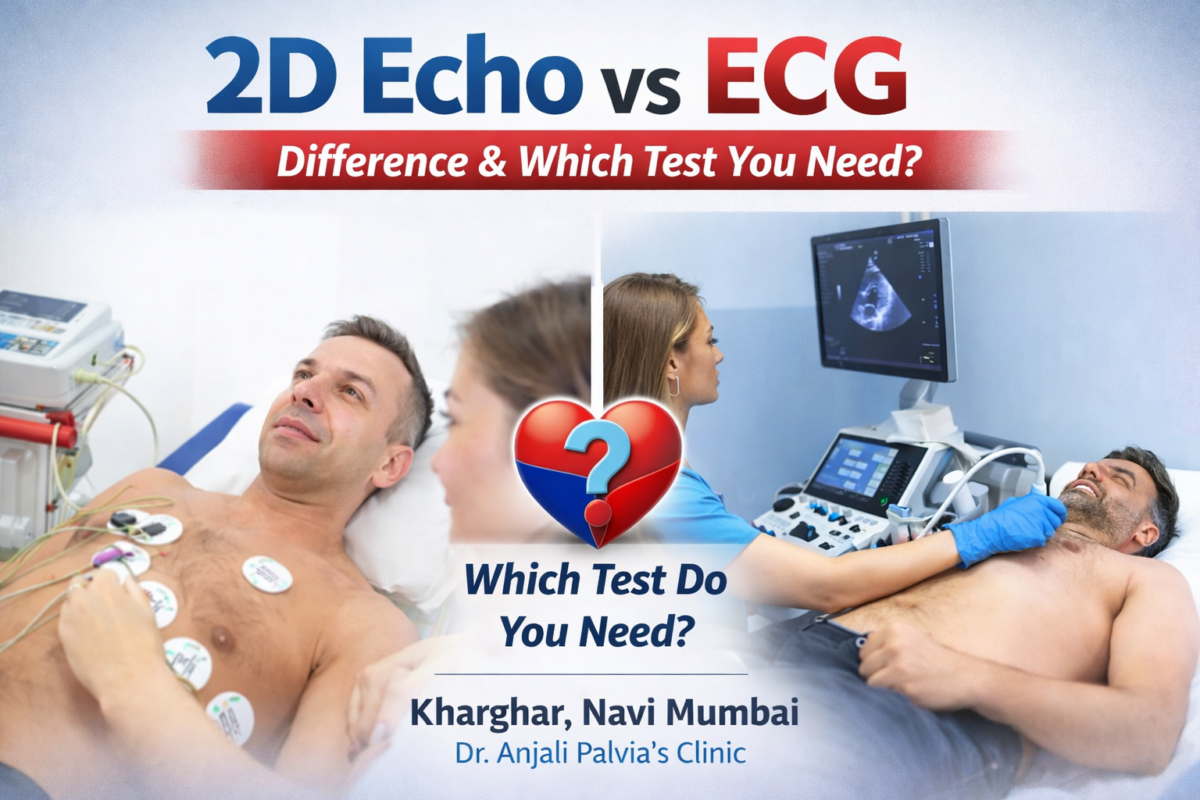
This is one of the most common questions patients ask at our clinic in Kharghar. So let’s break it down in simple, everyday language. No medical jargon, no confusion. ECG vs 2D Echo is one of the most common questions patients ask at our clinic in Kharghar. If you have ever been confused about which heart test you need, you are not alone. Both tests are simple, painless, and widely used, but they serve very different purposes. So let us break down ECG vs 2D Echo in simple, everyday language with no medical jargon and no confusion so you can clearly understand which test is right for you and when you might need it.
What Is an ECG?
ECG stands for Electrocardiogram. Think of it as a snapshot of your heart’s electrical activity. Small sticky electrodes are placed on your chest, arms, and legs, and within 5 to 10 minutes, the machine prints out a graph showing how your heart is beating. An ECG is great at catching irregular heartbeats, past heart attacks, and rhythm problems. It’s quick, painless, and usually the first test a doctor orders when you walk in with chest pain or palpitations.
But here’s the thing. An ECG only records electrical signals. It cannot show you what the heart looks like inside or how well it’s actually pumping.
What Is a 2D Echo?
A 2D Echo (Echocardiogram) is an ultrasound of your heart. It uses sound waves, not radiation, to create real-time moving images of your heart’s chambers, valves, and walls. Getting a 2D Echo Test in Kharghar at Dr Anjali Palvia’s clinic takes about 20 to 30 minutes. You lie on your side, a gel is applied to your chest, and a small probe is gently moved across the skin. That’s it. Completely painless.
A 2D Echo can detect valve problems, weak heart muscle, fluid around the heart, and pumping efficiency (ejection fraction). Things and ECG simply cannot be shown.
ECG vs 2D Echo: Know the Difference
| Feature | ECG | 2D Echo |
| What it measures | Electrical activity | Structure & function |
| Test duration | 5 to 10 minutes | 20 to 30 minutes |
| Uses radiation? | No | No |
| Does it detect valve disease? | No | Yes |
| Detects arrhythmia? | Yes | Limited |
| Shows ejection fraction? | No | Yes |
| Does it detect heart failure? | Partially | Clearly |
| Best for | Rhythm problems | Structural problems |
When Should You Get an ECG?
Your doctor will usually recommend an ECG if you have palpitations, chest discomfort, or dizziness. Or if you need a pre-surgery cardiac clearance. It’s fast, affordable, and a great starting point. But if your ECG comes back with something unusual or even normal while symptoms persist, the next step is almost always a 2D Echo.
When Should You Get a 2D Echo?
A 2D Echo Test in Navi Mumbai is strongly recommended if you have breathlessness, swollen legs, or chest pain, or if you’ve been diagnosed with diabetes or high blood pressure. These conditions silently damage the heart over time, and a 2D Echo catches that damage early, even before you feel anything wrong.
At Dr Anjali Palvia’s clinic, she specifically recommends a 2D Echo Test in Kharghar for all diabetic and hypertensive patients at least once a year. Early detection makes treatment far simpler and more effective.
Both ECG and 2D Echo use zero radiation and are completely safe for all age groups, including the elderly and pregnant women.
Do You Need Both Tests Together?
Absolutely and quite often, yes. ECG and 2D Echo are not competing tests, they are complementary. For example, if your ECG shows an irregular rhythm, a 2D Echo helps find out if there’s a structural reason behind it, like a valve problem or a weak heart wall.
Many patients who visit us for a 2D Echo Test in Navi Mumbai end up getting both done in the same visit, giving the doctor a full and complete picture of their heart health.
Which Test Is Right for You?
- Palpitations or irregular heartbeat – ECG first
- Breathlessness, chest pain, or swollen feet – 2D Echo
- Diabetic or hypertensive – 2D Echo strongly recommended
- Over 40 with no prior heart checkup – both tests advisable
- Pre-surgery cardiac clearance – ECG first, 2D Echo if needed
- Routine annual checkup – ECG is a good start
Of course, the best person to decide is your doctor, not Google. If you’re unsure, just book a consultation and let your physician guide you.
Why Choose Dr. Anjali Palvia for Your Echocardiography Tests in Kharghar?
There are many places to get a heart test done in Navi Mumbai, but what makes the difference is not just the equipment, it’s who reads your report and what they do with it.
- MD Physician with specialised training in 2D Echo and stress tests
- Reads every report personally and explains it to you in plain language
- Treats both diabetes and cardiac conditions together under one roof
- You never leave with just a report. Dr. Anjali Palvia at Kharghar Medicity Hospital, Navi Mumbai, walks you through your results and next steps clearly
Conclusion
An ECG tells you how your heart’s electrical system is behaving. A 2D Echo shows you how your heart looks and functions structurally. Both are painless, radiation-free, and together give your doctor the clearest possible picture of your heart health.
If you’ve been putting off your heart checkup, this is your sign to stop waiting. Whether you need a 2D Echo Test in Kharghar or a routine ECG, Dr Anjali Palvia’s clinic at Kharghar, Medicity Hospital, is here for you. Book your appointment today and take the first step towards a healthier heart.